
EUDR April Review: What's Changed and What You Need to Know
A breakdown of the EU Commission’s April 2026 EUDR Review Package, including updated guidance on product scope, operator roles, TRACES, due diligence, and what businesses need to do now to prepare for compliance.

Following months of anticipation, the EU Commission published its highly awaited April Review Package for the EU Deforestation Regulation (EUDR). In May 2026, we hosted a webinar breaking down everything that came out of that review, including key clarifications on roles, product scope, and what businesses should be doing right now.
The below clarifications are based on the updated April ‘26 FAQs and Guidance document.
The Timeline Hasn't Changed
First things first: the enforcement dates remain fixed. EUDR will be enforced from 30 December 2026 for non-SMEs, and from 30 June 2027 for SMEs not already subject to EUTR. The European Commission has made clear it will not be re-opening the regulation.
One important nuance: the SME extension applies to EU companies only. Non-EU SME suppliers do not benefit from the six-month grace period.
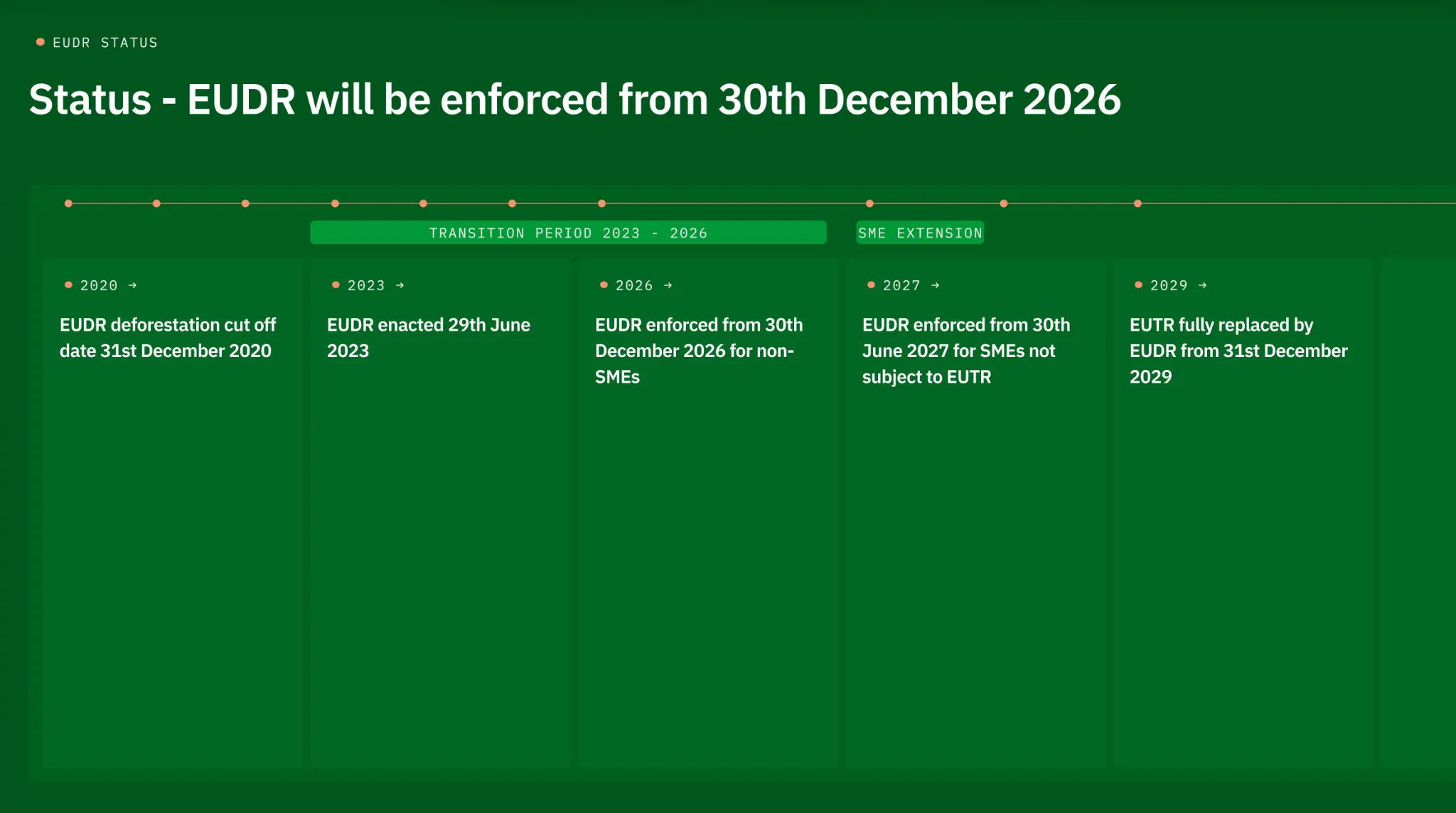
You can read more in our blog on transition periods here.
What's Still Being Finalised
A few regulatory pieces are still in progress that businesses should keep an eye on:
The Delegated Act (which formally confirms which products are in scope) is currently open for public consultation until 1 June 2026. The Implementing Act, which provides guidance on the TRACES system, is currently with EU Member States.
Additionally, updated TARIC code guidance is expected, and some countries are already writing EUDR into national law while remaining National Competent Authorities are still being appointed.
Changes to Product Scope
The April Review Package proposed some changes to the list of in-scope products under Annex 1. These changes still need to be formally agreed following the public consultation, and commodities will continue to be reviewed over time.
Proposed exclusions from Annex 1:
- Leather from cattle
- Bamboo, rattan, and other woody natural materials (reeds, rushes, osier, raffia, cleaned/bleached/dyed cereal straw, lime bark)
- Packaging, whether single-use or reusable, when used to protect products (regardless of whether those products are in-scope)
- Samples of negligible value and volume used for examination, analysis, or testing
- Marketing materials and brochures accompanying products
- Waste, used, and second-hand materials (note: by-products of manufacturing, such as woodchips, are not considered waste and remain in scope)
- Retreaded rubber tyres (only the new rubber used in re-treading remains in scope)
- Items of correspondence such as direct mail marketing
Proposed additions to Annex 1:
- Soluble (instant) coffee
- Certain palm oil derivatives, including soap made with palm oil
- Frozen cattle products
A few reminders when checking whether your products are in scope: always cross-reference Annex 1 HS/CN codes, consider composite products carefully, and remember that "Ex" in a product code means "extracts of", not "excluded."
You can read more in our Q&A on in scope products here or watch our webinar on the topic here.
Updated Roles and Obligations
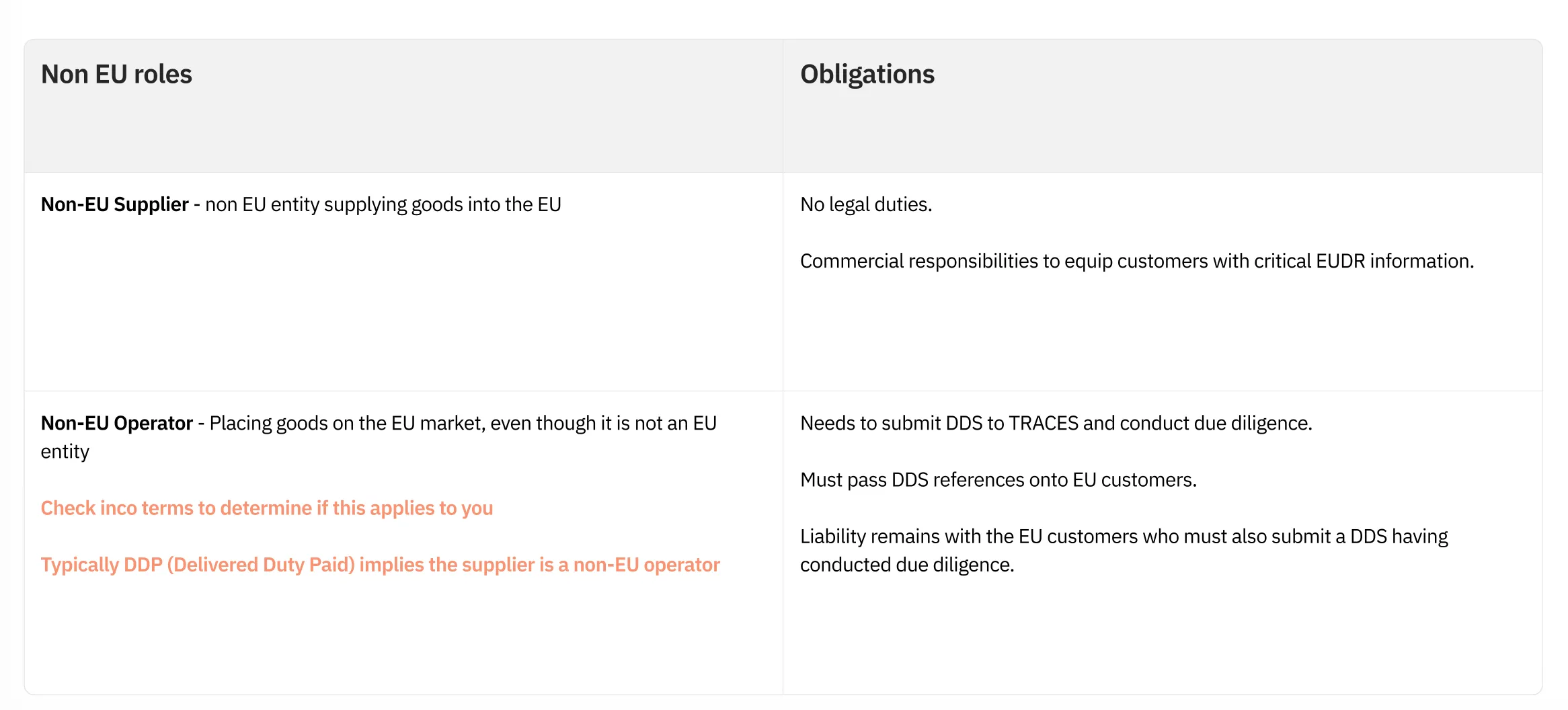
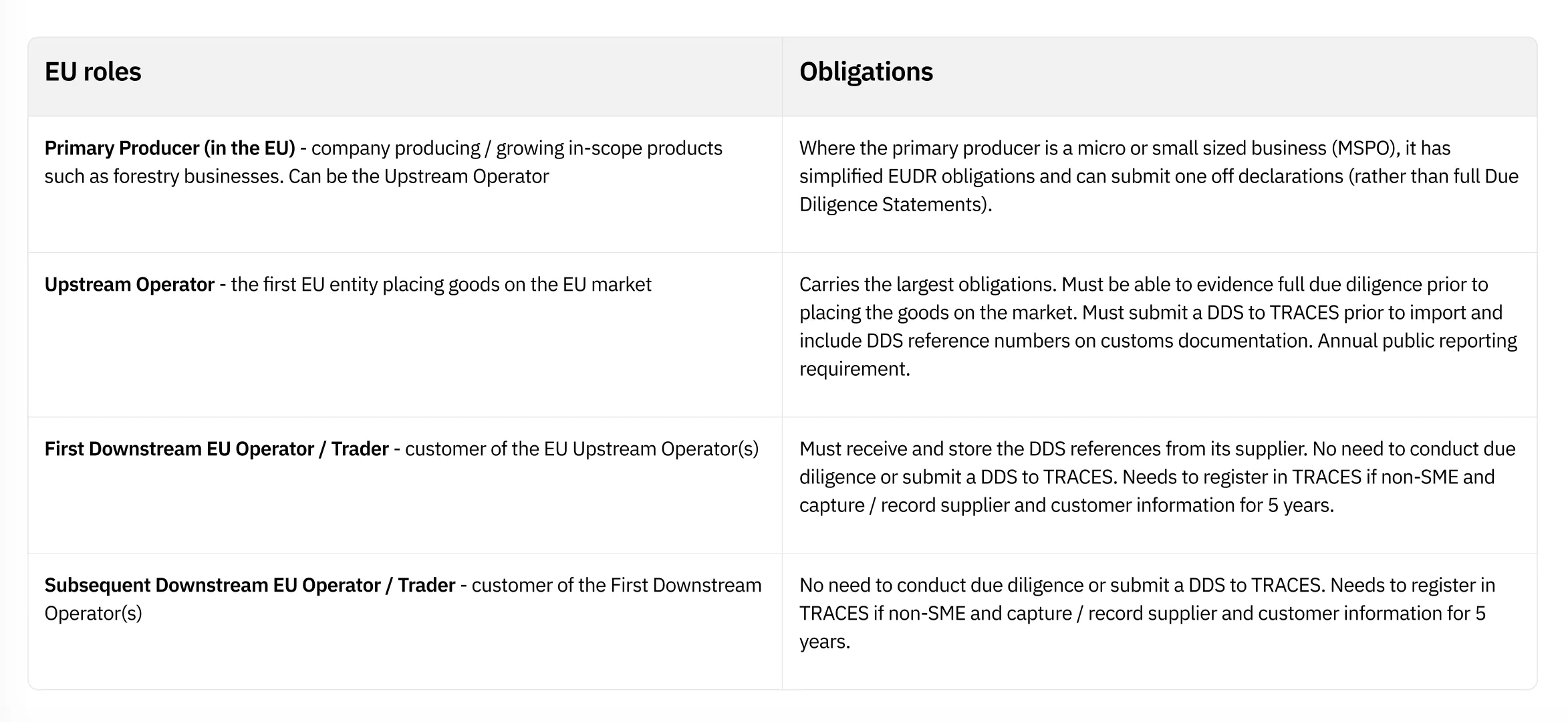
The April Review brought welcome clarity on how different roles in the supply chain are defined and what each one is actually required to do.
Non-EU Companies
EU Companies
What the FAQs Clarified About Downstream Operators
Some of the most practically useful clarifications in the April Review Package related to how Downstream Operators should operate.
- On receiving DDS references (FAQs 3.4 and 3.5): The first downstream operator is not required to proactively request DDS references or investigate their supply chain position unless they already have reason to believe their supplier is an Upstream Operator. The onus is on the Upstream Operator to self-identify. That said, if a downstream operator is aware that their supplier is an Upstream Operator and that supplier hasn't shared DDS references, the downstream operator must not place those goods on the market (FAQ 1.27).
- On substantiated concerns (FAQ 3.6): Verifying that due diligence has been done by Upstream Operators is a reactive obligation, not a routine one. It only needs to happen when substantiated concerns arise, and can be done by checking the validity of DDS references or collecting additional information from suppliers.
- On submitting a DDS voluntarily (FAQ 3.10.1): The Commission does not foresee technical provision for a downstream operator to submit a DDS even if it wished to.
Micro/Small Primary Operators (MSPOs)
A MSPO is a Primary Operator (an EU entity selling products it grows or harvests itself) that operates from a low-risk country and meets at least two of the three size thresholds below, based on the previous financial year's reporting:
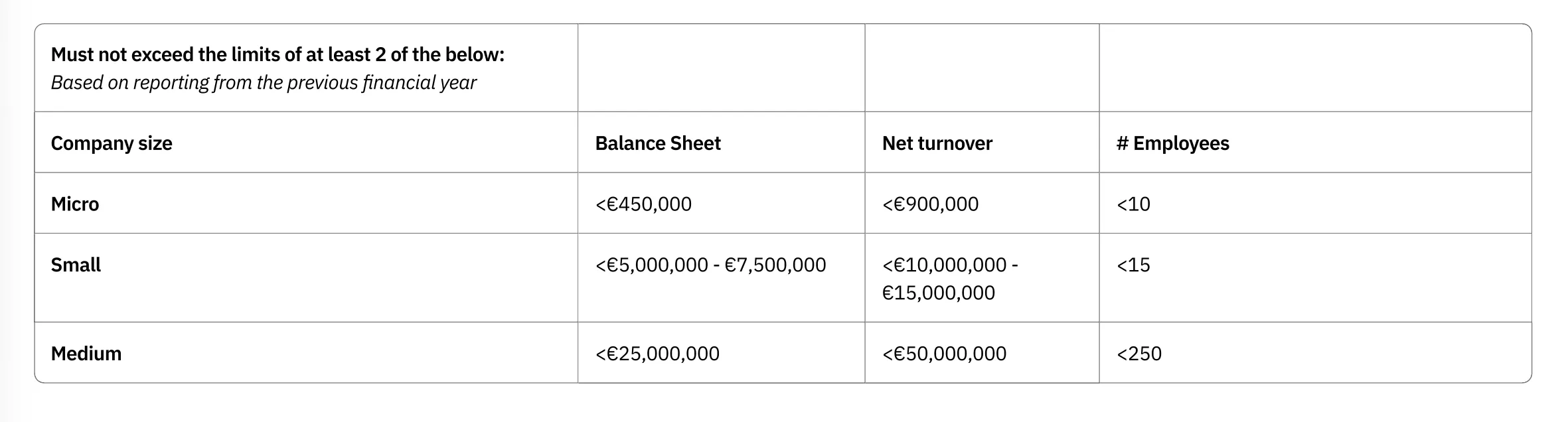
Note: definitions of "small" may vary by member state.
MSPOs benefit from simplified obligations, including:
- Submitting a one-off Simplified Declaration in TRACES (returning a Declaration Identifier), rather than a full DDS for each transaction. This declaration must be updated if something changes in the supply chain, such as harvest dates or HS codes.
- Relying on national systems where these exist
- Providing postcodes instead of GPS coordinates
A change in size classification only occurs when a company exceeds (or ceases to exceed) two of the three thresholds for two consecutive financial years (FAQ 3.24). Where a company has mixed activities, the MSPO classification can be based on the portion of the business related to the relevant commodity, not the whole company (FAQ 3.25).
You can read more about size of company and obligations here.
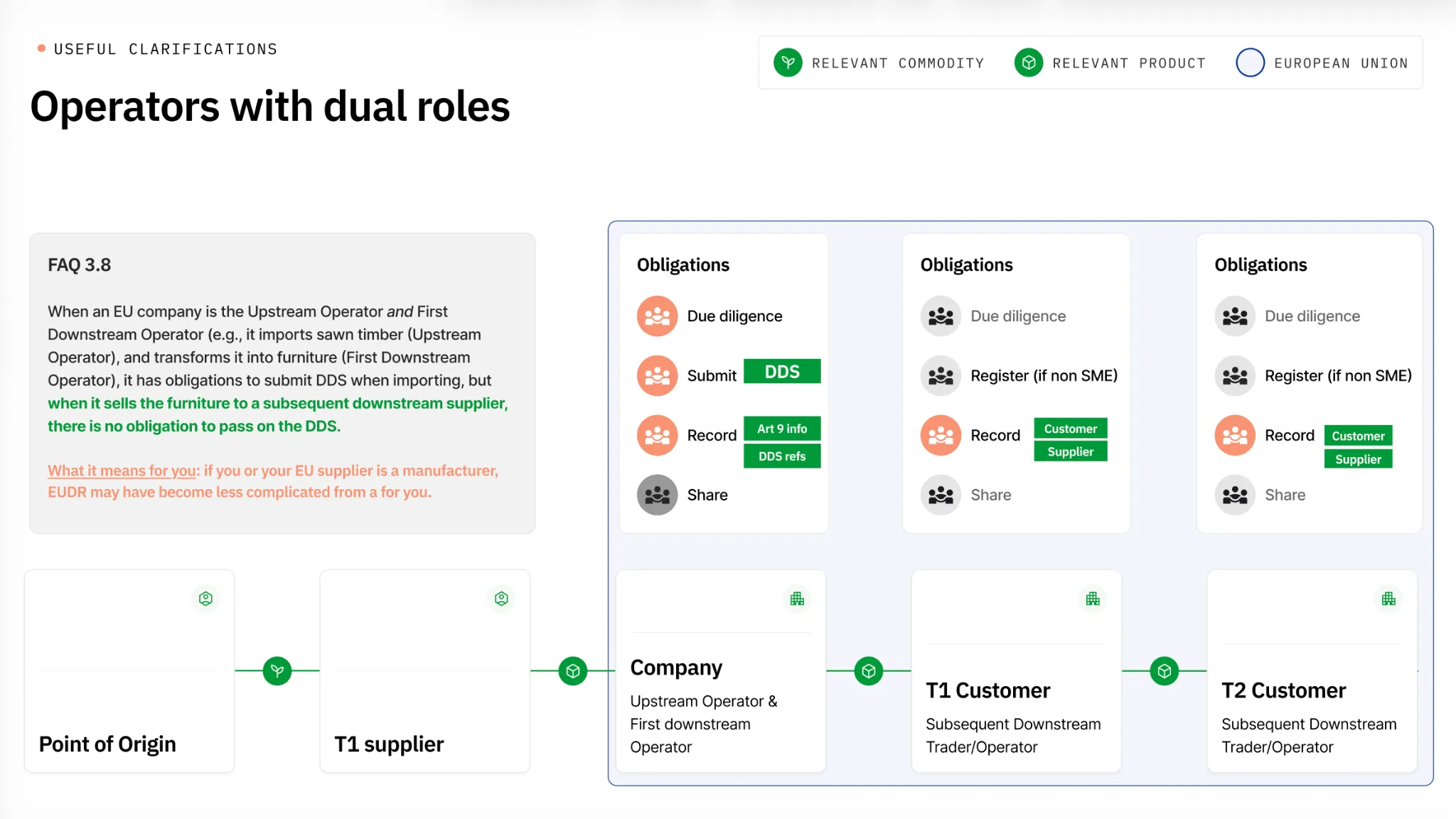
Operators with Dual Roles
FAQ 3.8 clarified the position of companies that are simultaneously an Upstream Operator and a First Downstream Operator. For example, a company that imports sawn timber (making it an Upstream Operator) and transforms it into furniture (making it a First Downstream Operator in relation to the furniture) must submit a DDS when importing, but has no obligation to pass DDS references on when it sells the finished furniture downstream.
This simplification means EUDR may be less complicated for manufacturers than previously understood.
Due Diligence Applies Even for Low-Risk Countries
This is an area where the April Review reinforced existing obligations rather than relaxing them. According to FAQ 1.28, there are no exceptions to the geolocation reporting requirement, including when sourcing from low-risk countries.
Upstream Operators must still assess supply chain complexity and the risk of circumvention or mixing with products from non-low-risk countries, even when applying simplified due diligence. Competent authorities are actively focusing on this. Guidance Document 4(a) underlines that data collection, risk assessment, and risk mitigation must be causally linked and tailored to the specific characteristics of the operator's business and supply chains.
Exporting and Re-importing
- On exports (FAQ 5.6.1): There is no requirement to submit a DDS on export unless the exporter is the Upstream or Primary Operator. Downstream Operators exporting products will use a dedicated TARIC code on customs declarations instead. More detail is expected once official guidance is published.
- On re-imports (FAQ 5.4): A company re-importing goods it previously placed on the EU market is treated as a Downstream Operator, provided it can demonstrate the goods were already on the EU market (via customs declarations, contracts, invoices, or bills of lading). Without that proof, it must assume the obligations of an Upstream Operator. Where the re-importer can demonstrate prior placement, it does not need to submit a new DDS and can rely on upstream DDS references or a conventional reference number.
Northern Ireland
Northern Ireland remains in scope of EUDR for now, pending further information relating to the Windsor Agreement between the UK Government and Northern Ireland. Companies based in Northern Ireland should prepare as though they carry full EUDR responsibilities based on their supply chain position.
Online Marketplaces and E-commerce
FAQ 3.18 confirmed that an online marketplace that simply facilitates a sales agreement between two parties, without intervening in the actual supply of the product, is treated as a mere intermediary with no EUDR obligations. However, this is a case-by-case judgement: if the marketplace also sells products directly, it may fall in scope.
For non-EU suppliers selling directly to EU consumers via e-commerce (FAQ 3.7 and 3.9): if the consumer purchases for private use and never places the product on the market, the consumer is not treated as an Operator, even if listed as the importer on customs documents. This means some non-EU e-commerce suppliers may no longer be in scope.
TRACES Updates
TRACES (the EU's trade control and expert system) has been temporarily closed during the first half of 2026 for upgrades. It is expected to reopen in June 2026 following testing. Updates include:
- Support for simplified declarations from MSPOs, aligned with the revised EUDR text and accessible via API
- Registration of new roles (MSPOs and non-SME Downstream Operators/Traders)
- Updated web service specifications
- A voluntary grouping feature
- The ability to duplicate an existing DDS
- Validation of DDS references via CSV functionality
Note: Please keep an eye on our LinkedIn page for our webinar on TRACES which we will schedule once the clarifications have been made public.
Annual Reporting for Non-SME Upstream Operators
Non-SME Upstream Operators will be required to publish an annual public report, with the first report due after 30 December 2027 (one year after enforcement begins). The required format and content are not yet confirmed, but based on EUTR precedent, expect a statement of compliance and confirmation of due diligence systems and procedures.
What to Do Now
If you haven't started preparing for EUDR, here's a straightforward order of priorities:
- Check whether your products are in scope, including packaging and composite products
- Identify your role and obligations across each relevant supply chain
- Build or review your due diligence system so you can collect, assess, store, and share the required information
- Engage internally and with your supply chain so everyone understands what information needs to flow, and when
- Configure your risk assessment templates and begin working through supplier expectations
- Run a gap analysis by drafting a test DDS submission to TRACES and assessing your geolocation data
Ready to Go Deeper?
Our platform, Interu, is built specifically to help businesses manage EUDR compliance: from collecting and validating supply chain data to organising records, assessing risk, sharing information securely, and maintaining audit-ready documentation.
If you have questions about EUDR or want to explore how Interu can support your compliance journey, you can reach us at contact@iov42.com. You can also sign up for a free trial account to run an initial gap analysis and start applying EUDR risk assessments.
Disclaimer: We provide a portal for the transfer of data from third party sources to individual users. You are responsible for ensuring that your use of the portal, including the data, is sufficient or appropriate for any particular use or circumstances, including taking independent professional advice as necessary. For the avoidance of doubt, you should always seek independent professional advice to confirm your compliance with applicable law.
Interu enhances traceability by allowing users to securely collect, prove and share information across complex supply chains, without compromising privacy.
.webp)
.jpg)
%20(1).webp)