
What Counts as a Micro, Small or Medium Business Under the EUDR - and What are Your Obligations?
Understand how micro, small and medium businesses are defined under the EUDR, what obligations apply, and where exemptions and simplifications exist.

Understanding whether your organisation qualifies as a micro, small or medium undertaking under EU law is an important first step in determining how the EU Deforestation Regulation (EUDR) applies to you. While the EUDR applies across the supply chain, it includes specific definitions, exemptions and phased obligations designed to reflect the capacity and impact of smaller organisations.
However, company size is only one part of the picture. Obligations under the EUDR also depend on where a business is based and what role it plays in the supply chain. This overview describes how those factors interact in practice.
This article explains:
- How micro, small and medium undertakings are defined
- What obligations apply under the EUDR
- Where exemptions and simplifications exist
- How downstream obligations differ for SMEs and non-SMEs
- What to expect from the upcoming review in April 2026
How Are Micro, Small and Medium Undertakings Defined?
The EUDR relies on the definitions set out in Directive 2013/34/EU. Member States classify undertakings based on financial and employment thresholds of your current financial year.
You’ll notice the term SME and non-SMEs referenced throughout the regulation - which stands for Small and Medium sized Enterprises. However when it comes to the EUDR, micro organisations also need to be factored in.
And to add to the confusion, unlike the obligations, the six-month extension to the application date of 30th December 2026 has two critical nuances:
- It applies only to micro and small undertakings, not to medium-sized ones. Medium-sized undertakings are therefore subject to the same application timeline as large undertakings.
- The eligibility for the extension is based on the company being a small / micro undertaking as of 31 December 2024.
Note: the extension is also not applicable for organisations of any size whose products fall in scope of existing EU Timber Regulation (EUTR).
More broadly, several EUDR obligations - especially for downstream operators - hinge on whether a business is an SME or a non-SME, rather than whether it is micro, small or medium. Understanding both classifications is essential to determining which requirements apply and when.
SMEs Must not exceed the limits of at least two of the following criteria:
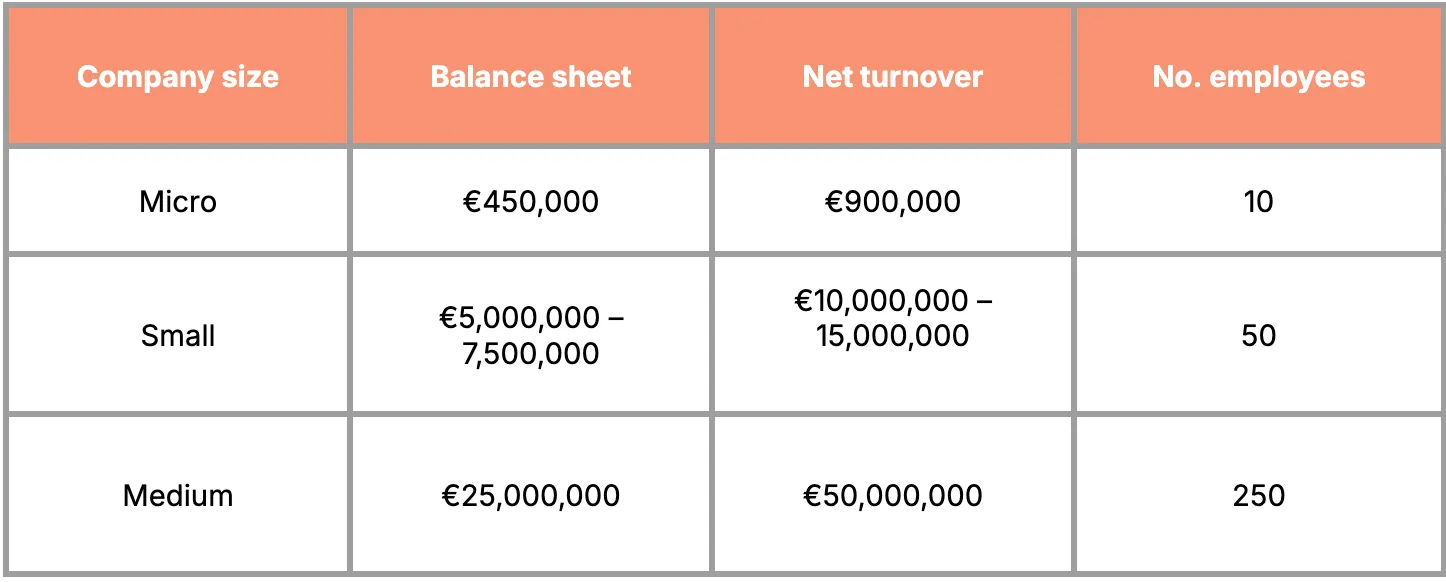
Note: Member States may define the thresholds for small undertakings within a specified range, provided they do not exceed a defined limit.
Non-SMEs must exceed the limits of at least two of the following criteria:
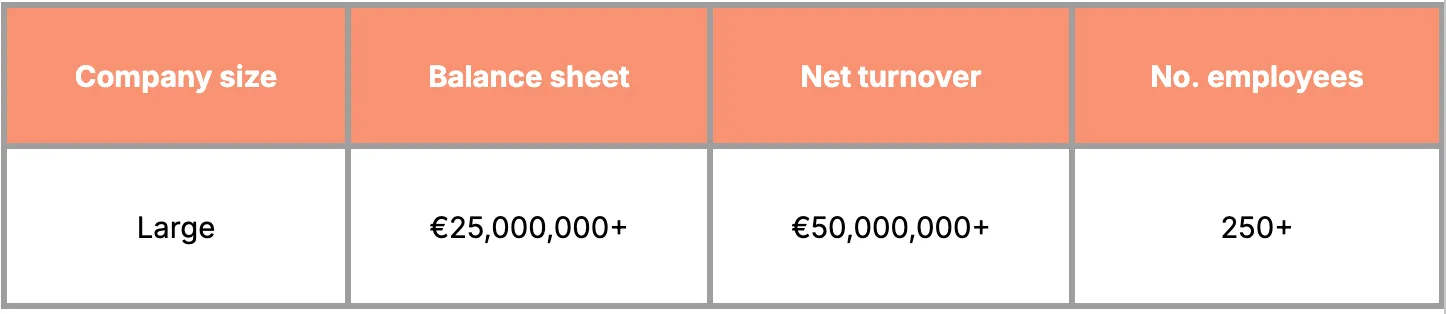
Employee numbers refer to the average employee number (actual FTEs (Full Time Equivalents)) during the course of the financial year. Headcount is based on the concept of ‘Annual Work Units’ (AWUs), to factor in part time staff and seasonal workers.
What Does This Classification Mean Under the EUDR?
Under the EUDR, obligations are determined not only by company size, but also by role in the supply chain and whether the business is established in the EU.
Micro and small undertakings may act as:
- Operators, placing relevant commodities or products on the EU market or exporting them
- Traders, making products available on the market after they have already been placed there by an operator
The Regulation recognises that smaller undertakings often have more limited administrative capacity and therefore includes targeted simplifications - but these apply only in specific circumstances.
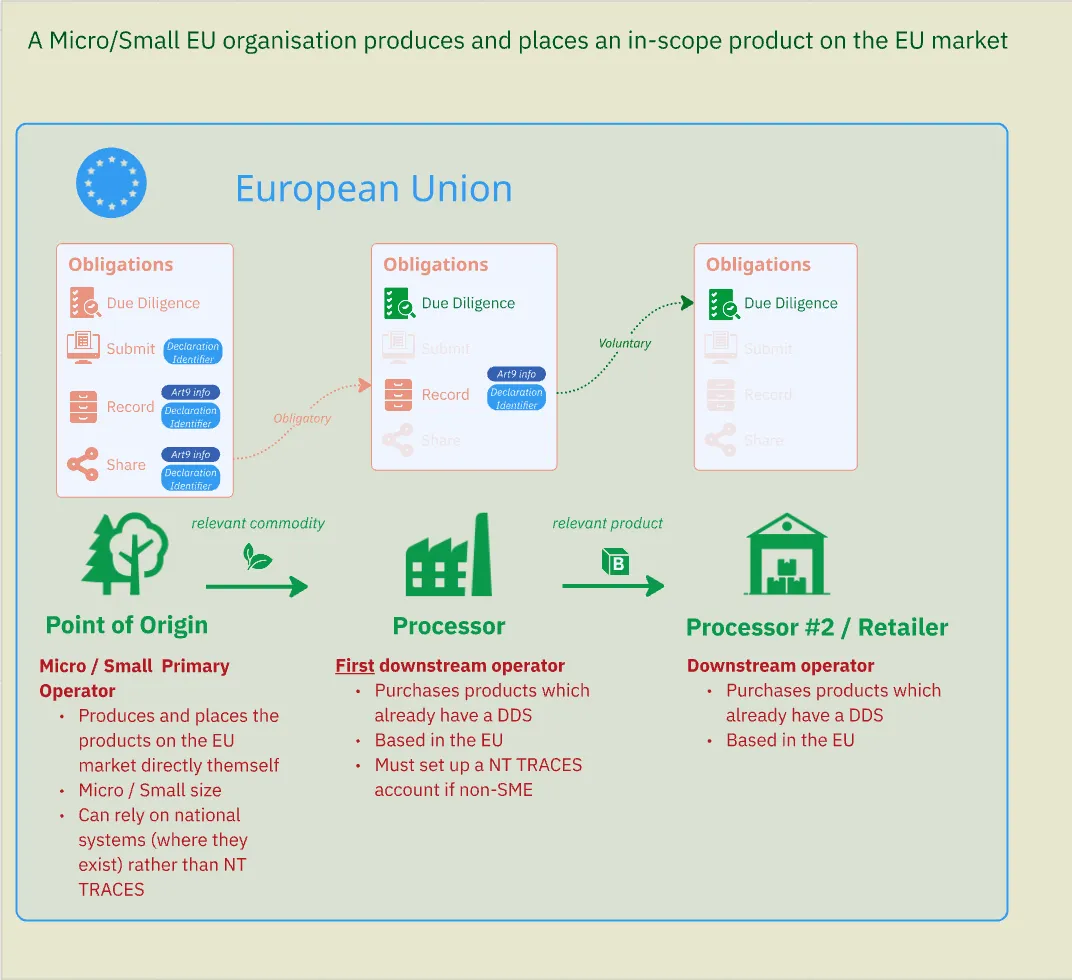
New Simplifications for Micro and Small Primary EU Operators
The December 2025 update introduced further simplifications for micro and small primary Operators in low-risk countries. Primary operators are EU organisations that both produce and place in-scope products on the market.
These primary operators may:
- Submit a one-off declaration in TRACES (refer to Annex III of the official EUDR text)
- Rely on national systems, where these exist
- Provide postcodes instead of GPS coordinates
These measures are intended to reduce administrative burden where risk is demonstrably low, without weakening the overall objectives of the Regulation.
These simplifications only apply to primary operators who place goods directly on the EU market, or export from it. Therefore in practice, the simplifications are likely to advantage EU based organisations rather than non-EU primary producers. Unless the non-EU primary producer classifies as an Operator placing goods on the EU market directly themself, then the simplifications do not apply.
EUDR Obligations for Micro and Small Operators (Who Are Not Primary Operators)
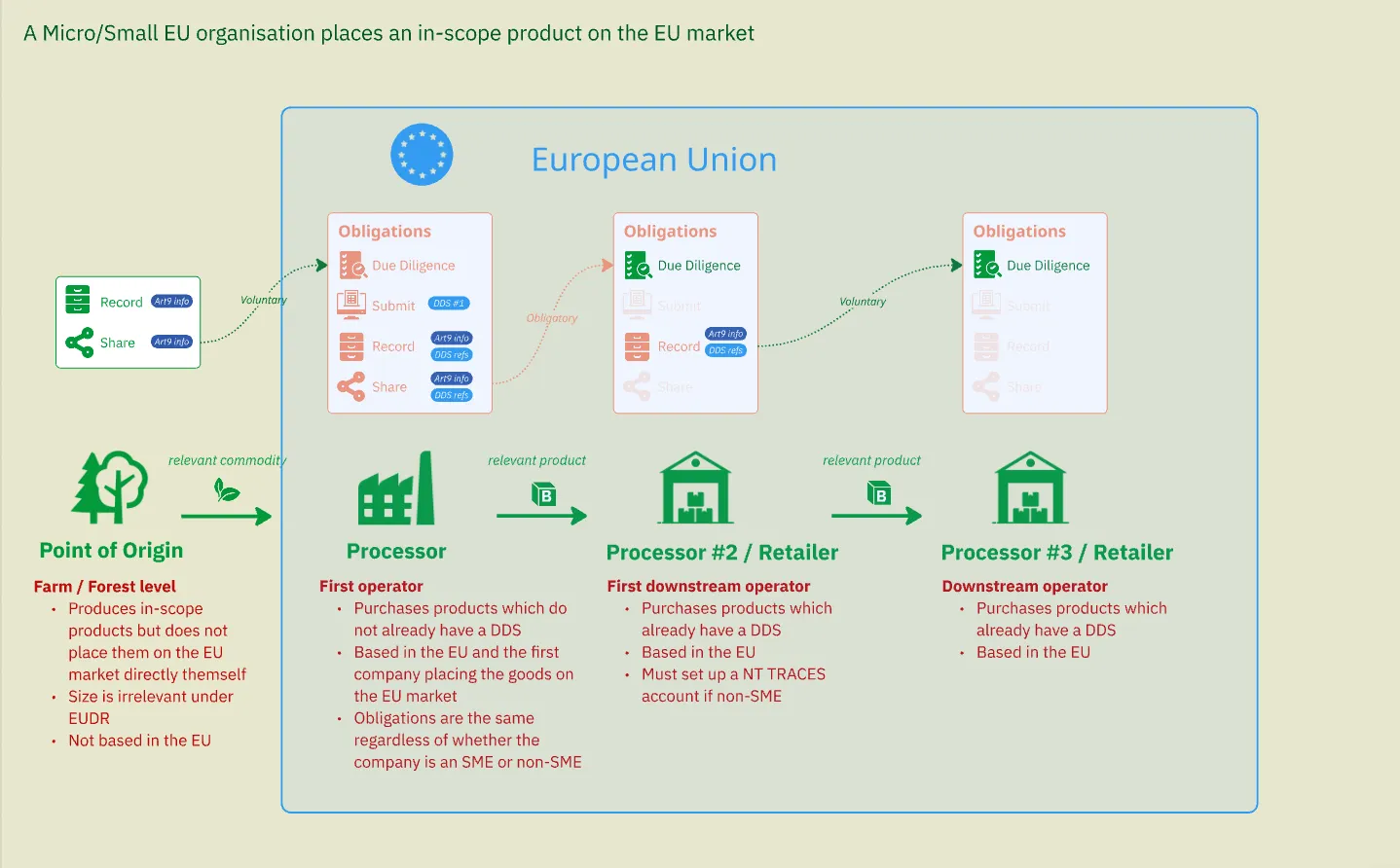
Where a micro or small undertaking acts as the first operator, the core EUDR requirements apply. Company size alone does not remove the due diligence obligation.
These organisations must ensure that relevant products are:
- Deforestation-free
- Produced in accordance with the relevant legislation of the country of production
- Covered by a due diligence statement before being placed on or exported from the EU market
To meet these obligations, operators must collect information on origin and production, assess and mitigate risk, and submit a due diligence statement through the EU information system.
Downstream Operators, SMEs and TRACES: What Actually Changes
Following the December 2025 update, all downstream operators - whether SMEs or non-SMEs - benefit from agreed simplifications. However, there is one important distinction that continues to apply for EU-based businesses.
- Where a downstream operator is not an SME, they must register in TRACES.
- Where a downstream operator is an SME, this registration is not required.
- This distinction applies only to EU downstream operators.
For non-EU businesses, SME status is irrelevant. Whether a company is micro, small, medium or large has no impact on downstream obligations if the business is not established in the EU. This caused considerable confusion in 2024, particularly among UK companies, many of which assumed SME status would reduce their obligations. Under the EUDR, it does not.
Simplified Obligations for Micro and Small Traders
Micro and small undertakings that act only as traders benefit from reduced requirements.
In these cases, they are not required to conduct full due diligence themselves. Instead, they must retain traceability information, including:
- The names and contact details of the operators or traders that supplied the products
- The reference numbers of the relevant due diligence statements
This information must be made available to competent authorities upon request. The intention is to avoid duplication of due diligence already carried out upstream, while preserving accountability and traceability.
Exemptions and Reduced Administrative Burden
The EUDR includes several mechanisms designed to ensure proportionality for micro and small undertakings:
- No obligation to submit a due diligence statement where acting solely as a trader and relying on upstream due diligence
- Proportionate enforcement, with Member States required to consider the size and economic capacity of the undertaking when applying penalties
When Do the Obligations Apply?
The EUDR applies on a phased basis. Micro and small undertakings benefit from later application dates than large undertakings (30th June 2027), giving them additional time to prepare systems and processes. This staggered approach reflects differences in resources and administrative capacity.
Note: this does not apply to organisations who are obliged by the EUTR (EU Timber Regulation.
Upcoming Review in April 2026
The Regulation requires the European Commission to carry out a simplification review ahead of the broader review scheduled for 2030.
Due by April 2026, the review will assess the administrative burden on micro and small operators and may result in further simplifications, technical guidance, improvements to IT systems, or targeted legislative changes. It is important to note, this does not impact the overall obligations - there has been no indication that the regulation itself will be under review.
Need clarity on how the EUDR applies to your business?
While the EUDR applies across the supply chain, micro and small undertakings are not treated in the same way as large enterprises - and SME status only matters in specific, clearly defined contexts. Obligations depend on role, location and risk, not assumptions.
Understanding where your organisation sits, and what that means in practice, is key to preparing for compliance.
Interu helps companies understand their obligations under the EUDR and navigate compliance with confidence. If you’re unsure how your business classification affects your responsibilities, get in touch with our team to learn how we can support you.
Anna Roberts, a social technologist and Head of Market Development at iov42, specialises in scaling solutions to enhance trust within multi-party networks. With a background in strategy consulting, she played a pivotal role in developing bespoke simulation technologies for leading organisations before venturing into sustainable trade networks as a square rig sailor.
Recent related content:
.webp)
Products & Commodities in Scope - EUDR Webinar Q&A
Explore key questions on which products and commodities fall within the scope of the EU Deforestation Regulation (EUDR), including packaging, gifts, tariff codes, composite products and evidence for out-of-scope components.
.webp)