.webp)
EUDR and Logistics: Who is Actually Responsible?
EUDR responsibility doesn’t sit with logistics providers. Learn who is legally accountable, how Incoterms affect liability, and how to avoid costly compliance risks.

As companies prepare for EUDR compliance, one question continues to surface: What role do logistics providers actually play?
At first glance, it seems obvious. Goods are transported into the EU by shipping companies, couriers, and freight forwarders. They handle customs processes, manage documentation, and physically move products across borders.
So surely, they carry some responsibility for EUDR compliance?
In reality, the answer is most likely no - and misunderstanding this can create significant risk.
Logistics providers don’t hold responsibility under EUDR
Under EUDR, responsibility sits with the operator or trader placing goods on the EU market. This is defined by legal ownership, not physical possession.
Logistics providers - whether DHL, UPS, or a freight forwarder - never take ownership of the goods they transport. They are facilitators, not participants in the transaction itself.
This distinction is critical.
Even if a logistics provider is:
- Handling customs documentation
- Presenting paperwork at the EU border
- Physically importing the goods
Per FAQ 2.1 “The EUDR does generally not establish obligations on those who offer logistical services along the supply chain (shipping agents/transport agents or customs representatives). They are not ‘operators’ or ‘traders’ in the meaning of the EUDR as far as they do not place products on the market or export.
Why this creates confusion
In practice, logistics providers often appear to sit at the centre of the process.
They are the ones interacting with customs authorities. They may be asked for documentation. They are often the last party to handle goods before they enter the EU market.
This creates a false sense of accountability.
Many companies assume that because logistics providers are operationally involved, they will also ensure compliance. But EUDR draws a clear line: compliance follows ownership, not movement.
So if logistics companies are not responsible, then who is?
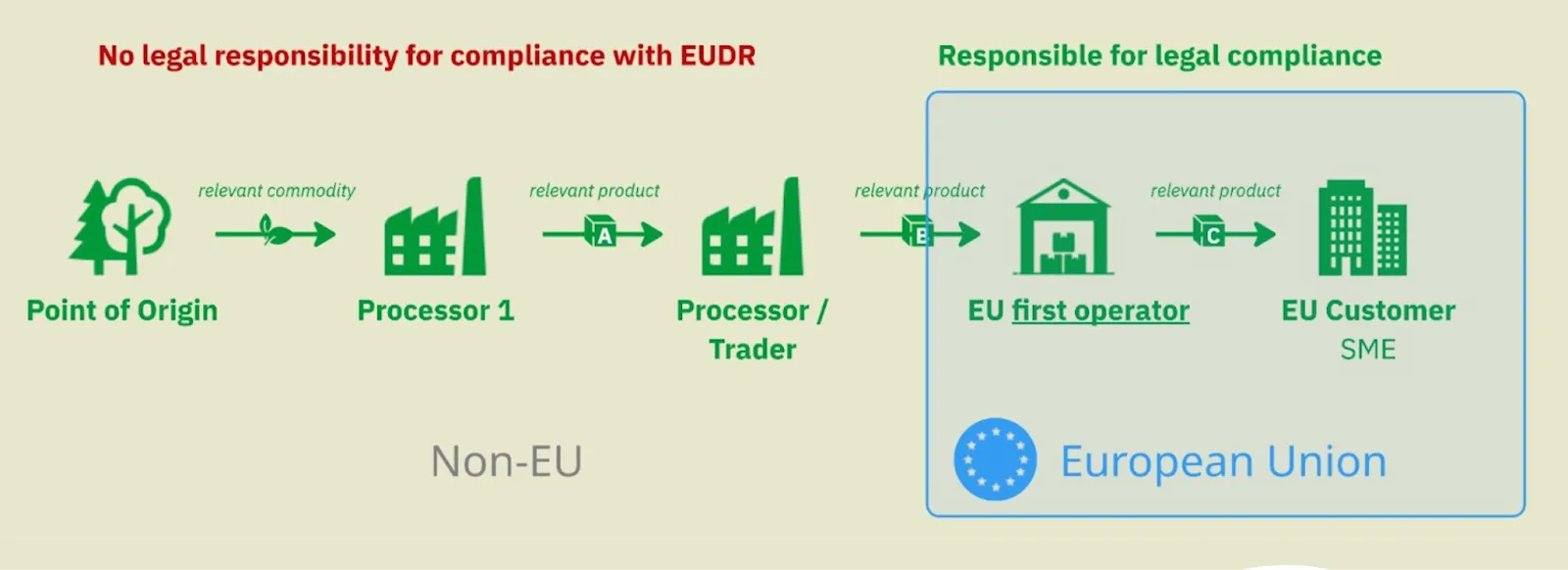
The headline of EUDR is that there must always be an EU operator who is responsible for compliance with EUDR.
Per the below diagram, this is largely the first operator, the importer of record. Therefore non-EU providers in most cases will not be legally liable, but do of course have commercial responsibility to provide their EU customers with all relevant information needed for the customer to comply.
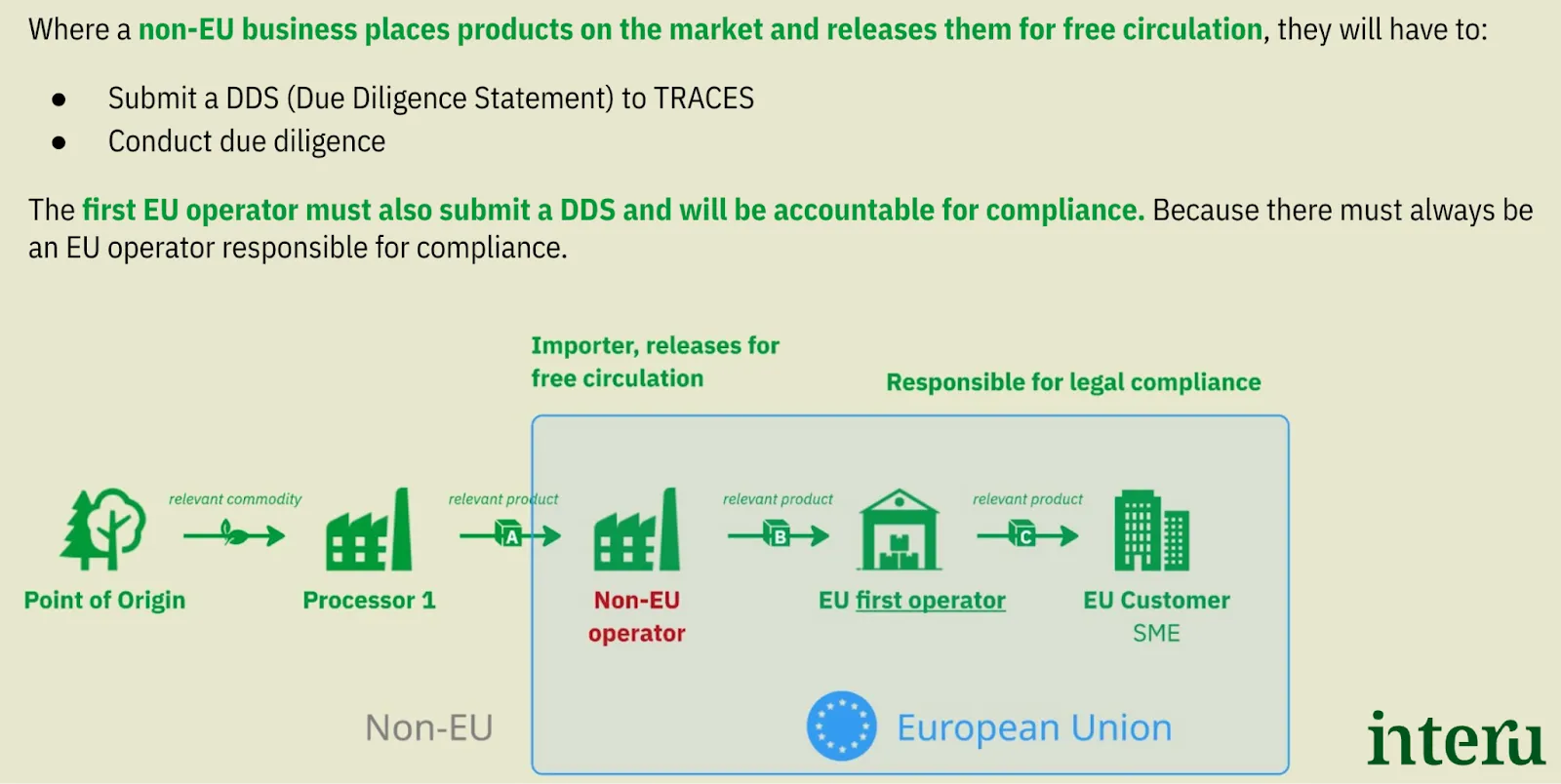
There will be situations where non-EU entities are the importer of record (see the diagram below). In this case, per the below diagram, the non-EU business must have an EORI* number issued by an EU member state (or Northern Ireland), and they are responsible for submitting a DDS to TRACES and conducting due diligence. However, their EU registered customer, as the first EU entity in the chain, is accountable for compliance. That customer must also submit a DDS to TRACES and retain full legal liability. The non-EU supplier will not be legally liable for non-compliance (though of course the customer will want to be able to rely on solid due diligence from the supplier).
The role of Incoterms
Where responsibility sits in practice often depends on Incoterms - the contractual agreements between buyers and sellers that define who is responsible for goods at each stage of the journey.
For example:
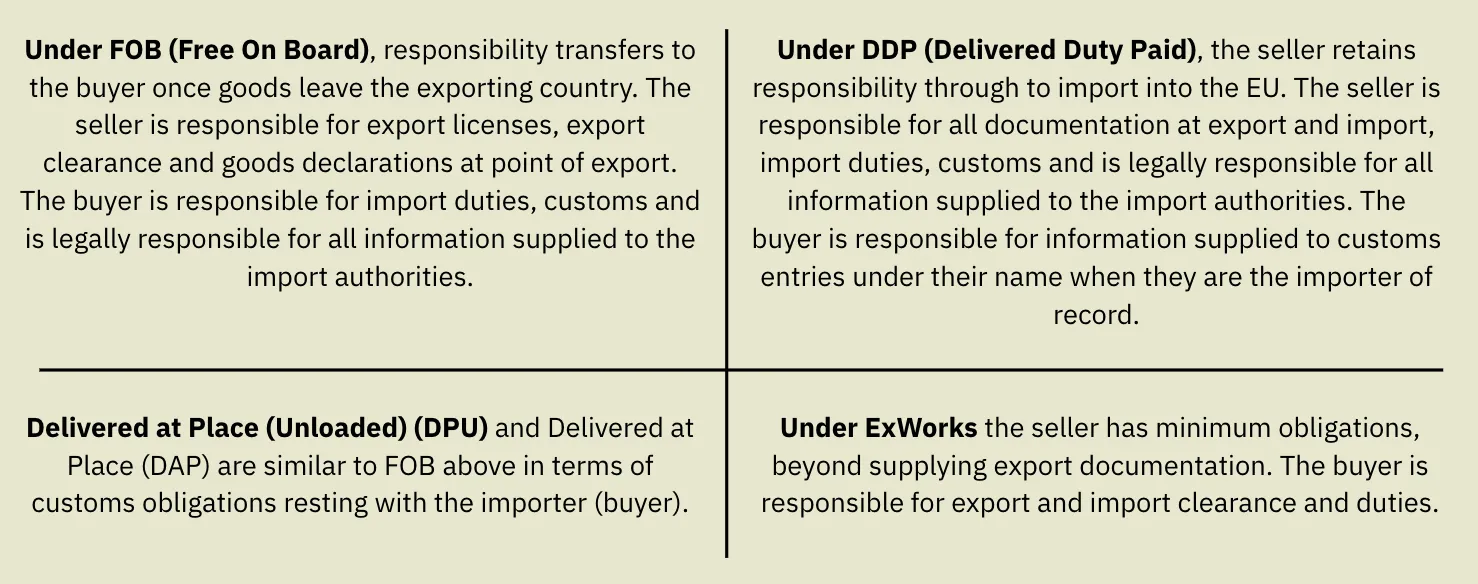
This means that responsibility for EUDR compliance does not sit with the logistics provider, but shifts between buyer and seller depending on the agreed terms.
Understanding this distinction is essential. Without it, companies risk assuming compliance is being handled elsewhere, when it isn’t.
A practical challenge: knowledge gaps in logistics
Another layer of complexity is that many logistics providers are still unfamiliar with EUDR requirements.
Over the past year, companies have increasingly asked their logistics partners: “Will you handle EUDR?”
In many cases, the response has been uncertainty.
This is not surprising. Logistics providers are not the intended audience of the regulation. They are not required to conduct due diligence, assess risk, or submit Due Diligence Statements.
But this creates a gap.
Because while they are not accountable for EUDR compliance, they are still responsible for carrying and presenting the documentation provided to them.
If that documentation is incomplete or incorrect, the consequences in relation to EUDR still fall on the operator or trader — not the logistics provider.
What this means in practice
For companies placing goods on the EU market, the implication is clear:
You cannot outsource EUDR compliance to your logistics provider. However, in some instances, the logistics provider may act as the EUDR Authorised Representative, an official role which sees the Authorised Representative submitting DDS on behalf of an operator. In this instance, the regulation is clear - liability still remains with the operator, not the Authorised Representative.
Instead, you need to ensure:
- Your Due Diligence Statements are accurate and correctly referenced
- All required documentation is passed clearly to logistics partners
- Responsibilities are explicitly defined in contracts and Incoterms
- Internal teams understand where accountability sits
In other words, logistics providers are part of the process but they are not part of the compliance obligation.
The risk of getting it wrong
If goods arrive at the EU border without the correct documentation, or if there is a compliance issue, the responsibility does not sit with the company transporting them. It sits with the company placing them on the market.
This can lead to delays, rejected shipments, or even the inability to sell goods within the EU.
A shift in mindset
EUDR requires a shift in how companies think about their supply chains.
It is no longer enough to know how goods move. Companies must understand who owns them at each stage, and who carries the regulatory burden.
Logistics providers remain essential partners, but they are not compliance partners.
That responsibility stays firmly with the business itself.
What about the upcoming EUDR review?
With the April review approaching, many businesses are watching closely for changes, delays, or further clarification.
While timelines and certain requirements may evolve, the core principle around responsibility is unlikely to shift.
EUDR is built on legal ownership and market placement. That means logistics providers, who never take ownership of goods, are not expected to become responsible for compliance.
So even in a changing regulatory landscape, this remains consistent:
Logistics moves goods. Responsibility stays with the operator or trader.
Navigating EUDR with confidence
Understanding where responsibility sits is only one part of the challenge.
In practice, companies are dealing with:
- Complex, multi-tiered supply chains
- High volumes of documentation
- Uncertainty around interpretation and implementation
- Ongoing questions as guidance continues to evolve
Getting this wrong isn’t just a compliance issue — it can disrupt your ability to trade.
How Interu can help
Interu is designed to help businesses navigate EUDR with clarity and confidence.
From structuring and managing Due Diligence Statements, to ensuring the right information flows across your supply chain and logistics partners, Interu gives you the visibility and control needed to stay compliant - without slowing down operations.
Whether you’re still interpreting requirements or actively preparing for enforcement, we can help you take the next step.
Get in touch to see how Interu can support your EUDR journey.
Interu enhances traceability by allowing users to securely collect, prove and share information across complex supply chains, without compromising privacy.
.webp)
