.jpg)
After years of preparation, delays, and amendments, the EU Deforestation Regulation (EUDR) is now a reality for EU operators. And while the regulation itself has been widely discussed, one question keeps coming up in conversations with our customers: what does enforcement actually look like in practice?
The honest answer is that it varies — and understanding that variation is part of operating smartly within the new landscape. Here's what you need to know, and more importantly, what you need to do.
The content comes from interviews with:
- those who have been part of Competent Authority (CA) EUTR (and test EUDR) inspections
- their suppliers
- third parties supporting companies with inspections
- our years of supporting the industry with traceability
- insights directly from a number of CAs
Enforcement Is Active, But Not Uniform
The EUDR places the primary due diligence obligation on the first operator or importer placing a product on the EU market. Once goods are on the EU market, downstream traders carry a lighter — though still real — responsibility. This structure means that as an importer, you are the first and most critical line of compliance.
Competent Authorities (CAs) across EU member states are responsible for enforcement, but their capacity and resourcing differ. Some CAs are well-staffed and actively requesting documentation; others are smaller operations handling a significant volume of trade with limited resources. The key takeaway here isn't that you can rely on lighter scrutiny in certain markets — it's that you should be prepared regardless, because that landscape can shift, and high-profile operators or those importing from particular markets are more likely to attract attention wherever they trade.
One industry operator shared their experience of exactly this dynamic, from their time importing sawn timber from Gabon under the predecessor EUTR regulation:
"We were running around 20–30 containers a month and thought that double-checking with our suppliers and archiving documents by container number was sufficient due diligence. Then one of our Gabon shipments was flagged for inspection. During the audit, it became clear how significantly we'd misread the law. What we'd been doing was purely administrative — it documented what our suppliers told us, but it didn't in any way demonstrate chain of custody or provide evidence that the logs hadn't come from illegal harvesting. We were given a period to improve, with the clear message that if nothing had changed on a return visit, we'd be facing a formal fine.
The auditor was candid about being overstretched — he covered a wide range of industries and wasn't a sector specialist. But he made it very clear that this didn't reduce our burden one bit. The responsibility rested entirely with us to demonstrate that we had genuinely done everything possible to mitigate risk. Don't mistake an under-resourced regulator for a low-risk environment. The obligation is yours, and when an audit does come, the standard you're held to doesn't flex."
It's a sobering reminder that good intentions and filing systems are not the same thing as due diligence.
For UK operators, the legal obligations under the UK Timber Regulations remain real and enforceable. If you're operating in Northern Ireland, it's also worth noting that the Windsor Framework means EUDR-level obligations may apply — something a growing number of UK businesses with depots there are now navigating.
What an Inspection Actually Looks Like - an example from The Netherlands
To understand what enforcement looks like in practice under the EUDR, it helps to hear directly from those carrying it out. A senior inspector at the NVWA — the Netherlands' CA and one of the more experienced enforcement bodies in the EU, having enforced the EUTR for a number of years — recently shared their approach.
The NVWA has invested significantly in preparing for the EUDR: hiring ten new inspectors, building internal training systems, and conducting trial inspections to assess industry readiness. Alongside this, they have delivered over 200 public presentations across sectors to set clear expectations with operators and traders ahead of formal enforcement.
The results of those trial inspections — carried out across 20 companies ahead of full enforcement, with companies who knew they were being assessed — make for sobering reading:
- Only 12 out of 20 were able to submit a Due Diligence Statement (DDS) in TRACES
- Only 7 out of 20 had collected enough information to support their DDS
- Only 9 out of 20 could clearly communicate what information they should be collecting
- 14 out of 20 had attempted a risk assessment — but only 3 of those 14 had done so sufficiently
- Only 5 out of 20 were able to identify risks satisfactorily
- Only 11 out of 20 had a Due Diligence System in place at all
- Just 4 out of 20 received a 'good' score outright — a further 4 improved after feedback
The gap between having documentation and having a functioning due diligence system is wider than many in the industry realise.
When an inspection is triggered, the process is structured and escalating. The NVWA selects companies to inspect based on due diligence statements submitted in the TRACES system. The operator will receive a request to provide details on a specific delivery — explaining what steps were taken to establish that the shipment met EUDR requirements, and how those checks were carried out. They will also be asked to demonstrate that their wider due diligence system is functioning correctly and is sufficiently robust.
From there, one of three outcomes follows:
- A letter confirming compliance — the company is meeting all requirements.
- A notice of remedial action — the company is given a defined period to improve its due diligence system. The NVWA will specify exactly what was missing and what needs to be addressed, followed by a reinspection.
- Escalation — if requirements are still not met after reinspection, a fine is issued alongside a further remediation period. If the company continues to fall short, the matter becomes a criminal case — and the NVWA has the power to publish the names of non-compliant companies.
The message is clear: enforcement is methodical, transparent, and progressive — but it does not stop short of serious consequences for those who fail to engage.
What Good Due Diligence Actually Looks Like
The EUDR requires due diligence, not just documentation. There's an important distinction. Proper due diligence has three components:
- Gather information — collect the relevant data about your supply chain, including geolocation of harvest areas, proof of legality, and evidence of deforestation-free sourcing.
- Risk assessment — evaluate whether the information you've gathered indicates a negligible risk of non-compliance.
- Risk mitigation — if risks are identified, take steps to address them before placing the product on the market.
Dumping a folder of documents on your CA — or on yourself — isn't due diligence. It's paperwork. The goal is structured, meaningful evidence that tells a clear story about your supply chain.
The Power of Rulesets: Telling Your Suppliers Exactly What You Need
One of the most practical things you can do right now is build clear rulesets for your suppliers. This means specifying, by country of origin, exactly what information you need — using the local names those documents are known by.
For example, a forest management plan in Brazil has a different name and format than its equivalent in Malaysia or Cameroon. Likewise a harvesting licence or an annual operational plan in one country might be called by a different term in another. If you're asking your supplier for "legal compliance documentation" without that specificity, you'll get back whatever the supplier thinks fits — the result being that you spend significant time checking through documents that may not serve your due diligence at all.
A good ruleset tells your supplier: "For shipments from your country, I need these specific documents — they're called X and Y locally — covering these specific points: forest-level fees, taxes, harvesting approvals, and indigenous community rights. Please upload them here, in this format."
This clarity saves time on both sides and makes your due diligence far easier to demonstrate to a CA.
Geolocation: Getting the Format Right
Under EUDR, geolocation data is mandatory. It is preferable that the coordinates you receive from your suppliers are in the correct format: the EU requires geocoordinates to be specified in the WGS 84 coordinate system (EPSG:4326). If the coordinates are supplied in a different system, then they must be converted to WGS 84. You must also ensure that they genuinely correspond to the harvest area — not a processing facility or export port. Being explicit with your suppliers about the required format upfront avoids delays and re-requests later.
Attitudes Are Shifting — Use That to Your Advantage
Something worth keeping in mind: supplier attitudes towards transparency are changing. For many timber-producing regions, the EU remains their most important export market. That market access is a powerful incentive, and producers who previously resisted detailed documentation requests are increasingly willing to engage — not necessarily because their values have changed, but because the commercial reality has.
This is actually good news for importers. It means that clear, specific requests — backed by the understanding that this is a condition of doing business — are more likely to be met than they would have been even two or three years ago. The conversation has shifted from "why do you need this?" to "tell me exactly what format you need it in."
Where Interu Fits In
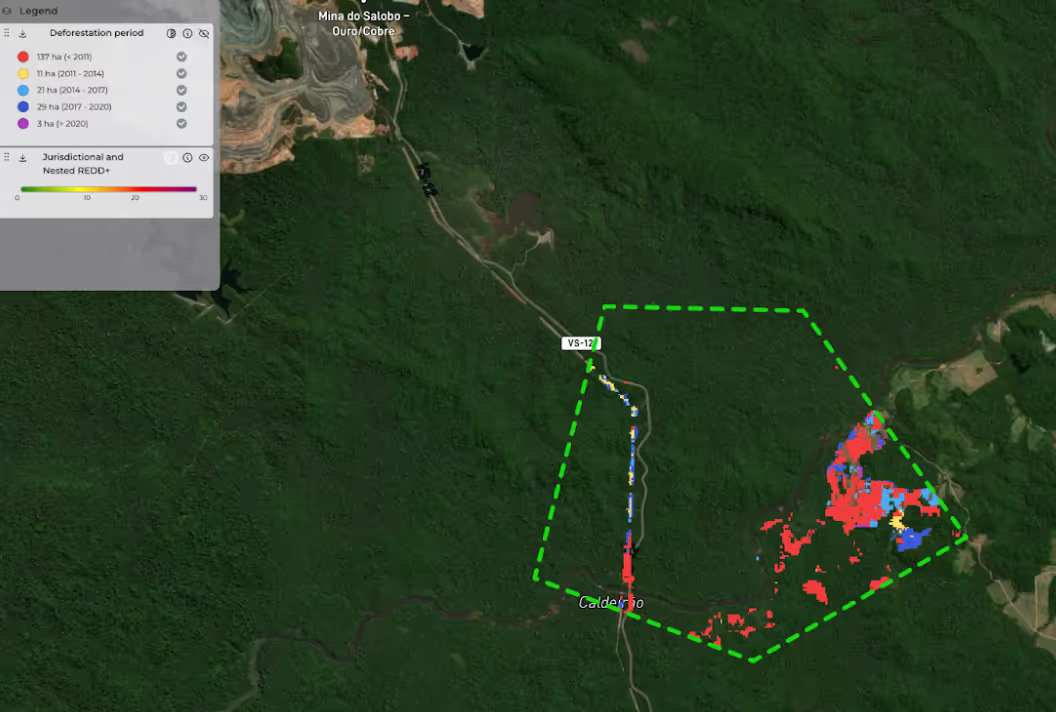
Managing due diligence across multiple suppliers, origins, and shipments is complex. Interu is built to make that complexity manageable — giving you a visual representation of your supply chain, structured document collection against your own rulesets, and a clear audit trail that you can stand behind if a CA comes knocking.
The regulation is here. The enforcement is active. The good news is that with the right approach — specific requests, structured evidence, and the right tools — compliance is entirely achievable.
Want to see how Interu can support your EUDR due diligence process? Get in touch with our team here.