EUDR customs codes explained: the TARIC codes and DDS references you need from December 2026
From 30 December 2026, the wrong customs code can hold EUDR goods at the border. Here are the TARIC codes and DDS references you need and what to do now.
.avif)
Most of the EUDR conversation so far has centred on due diligence: mapping suppliers, collecting geolocation data and filing statements in the EU Information System. The customs border is where all of that work gets tested. From 30th December 2026, an EUDR product can be held at the border simply because the right code is missing from the declaration.
The European Commission has now published updated TARIC guidance for the EU Deforestation Regulation. It sets out the codes to be entered on customs declarations when relevant products are imported or exported from the EU. Alongside it, the Commission has published a new conventional DDS reference number for re-imports after the transition period ends.
Below, we walk through what each code means, who needs it, and what to do now so your goods keep moving.
What it means for you
Every import or export of an EUDR product needs the right code on the customs declaration. If a due diligence statement or simplified declaration is required and no valid code is given, customs will not release the goods.
Before going into the details, there is an important distinction to be made between:
- A TARIC code (commodity code) identifies the goods. It has 10 digits: the first 8 are the Combined Nomenclature (CN) code and the last 2 are the TARIC subdivision.
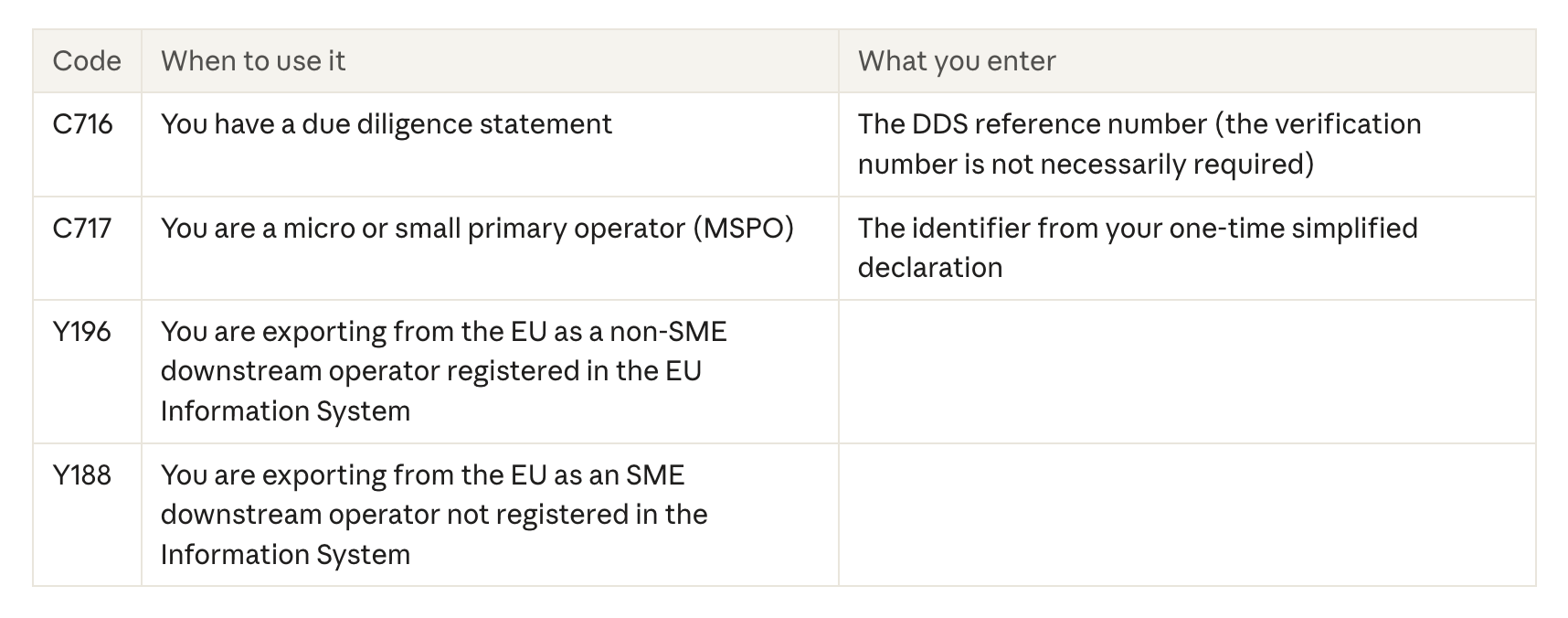
- A TARIC document code identifies a document, certificate, exemption or condition linked to the goods. It is 4 characters: a letter plus 3 digits (e.g. C716, Y132).
The TARIC code (commodity code) goes in Box 33 on the Single Administrative Document (SAD) - the older, paper based version of the customs declaration.
The TARIC document code, goes in Box 44 (Additional information / Documents produced / Certificates and authorisations), with the DDS reference number where relevant.
Standard EUDR TARIC document codes for customs declarations
Re-importing products previously placed on the EU market
Three codes cover goods coming back into the EU. Which one you use depends on your size, your registration status and when the goods were first placed on the market.
C720: non-SME downstream operators. Quote the reference number or declaration identifier if your upstream supplier(s) gave it to you. If they did not, use the newly published conventional DDS reference number 22EU2222222222. Be ready to show evidence that the goods were previously in the EU, such as purchase orders, export declarations, waybills, packing lists or contracts.
C725: SME downstream operators not registered in the Information System. Quote the reference number or declaration identifier your upstream supplier gave you. If you don't have one, use the conventional DDS reference number 22EU2222222222, and keep the same kind of evidence to hand.
C718: products placed on the market during the transitional period (30 June 2023 to 30 December 2026). For goods in this scenario, the conventional DDS reference number is 99EU9999999999.
For more on the conventional DDS reference numbers, see FAQ 9.2 for the transitional period here and the guidance on the post-transition reference number here.
New exemption codes
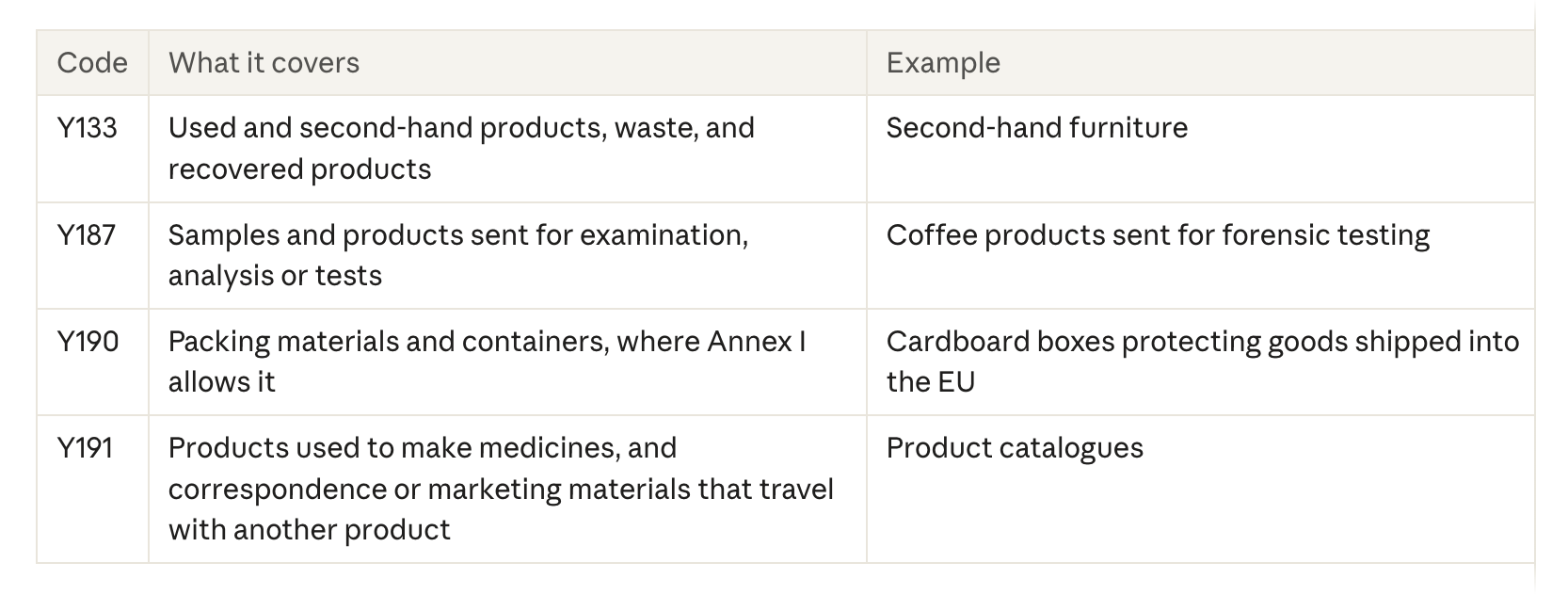
Y190 deserves a closer look. It covers packaging used only to support, protect or carry another product, and presented with that product. It applies to single-use packaging, and to reusable packaging such as pallets and crates from the moment it is used for that purpose. Packaging imported or exported as a product in its own right, such as a shipment of empty boxes, has no EUDR exemptions without satisfying other conditions (e.g., it is made of 100% recycled materials).
What to do now
- Check which codes apply to you, based on whether you import or export, your role in the supply chain and the size of your business.
- Share them with your customs broker or freight forwarder so they appear on your customs documentation.
- Make sure your due diligence statement references or declaration identifier are ready to pass along your supply chain where required.
You can read the full TARIC document here.
Get ready for December
These codes turn EUDR compliance into something customs can check on every single shipment. A missing reference number or the wrong code can leave goods sitting at the border, and with them your customer commitments. The businesses that move smoothly through 30th December will be the ones whose DDS references, supplier data and evidence are organised and easy to hand to a broker.
The re-import rules make record-keeping matter even more. If you plan to rely on the conventional reference numbers, you will need purchase orders, export declarations and packing lists to back them up. Now is a good time to check where those documents live and who can find them quickly.
Interu keeps your supplier data, due diligence statements and reference numbers in one place, ready for every customs declaration. If you'd like to see how it works for your products, book a demo with our team.
Andrew is an experienced Customer Success leader with over 18 years in SaaS, project management, and ESG. Passionate about driving client success and sustainability, he has led global portfolios, built high-performing teams, and delivered innovative programmes across start-ups and scale-ups.
Recent related content:
.webp)
.webp)
What Can Block or Accelerate Onboarding to Reach EUDR Compliance?
The journey to EUDR compliance is rarely straightforward. Each organisation begins from a different place - with different systems, data maturity, and levels of readiness. This blog from our Head of Customer Success outlines what can block or accelerate progress.
%20(1).avif)