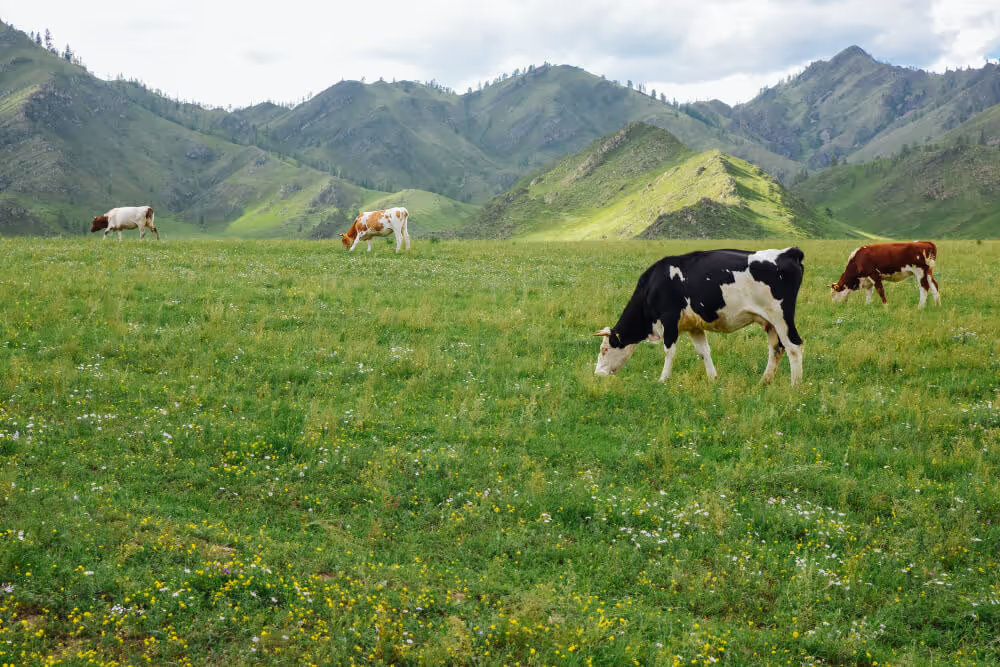
Enhancing Halal traceability and building trust in the market
Enhance Halal food traceability with iov42's Interu, a solution developed in collaboration with Prime UK. Leveraging Blockchain Connected funding and Welsh Government support, we address fraud concerns in the Halal market by ensuring digital identities, data integrity, transparency, and authenticity.

In an increasingly interconnected world, the journey of food from farm to fork has become a complex and multifaceted process. Consumers are demanding more transparency, and the food industry is facing growing pressures to embrace innovative solutions. At the centre of this shift lies the need for traceability, something that not only safeguards food integrity, but also paves the way for more of a responsible and sustainable food supply chain.
One example of a strong need for improved traceability is the Halal food sector, which has been facing a large problem with fraudulent products. Multiple scams to disguise meat as Halal, when in reality it is either a different meat entirely such as pork coated in oxblood, was not slaughtered according to Islamic customs, or was not sourced from approved stakeholders, such as Halal Industry Development Corporation (HDC).
With Halal product consumption growing, so has mislabelling and contamination. The Halal Certification Organization (HCO) only certifies products that meet Halal standards in an effort to combat fraud. However, we believe we can strengthen the HMCs efforts to tackle this problem by strengthening the digital identities, data integrity, transparency, and authenticity of the Halal market to aid companies in developing better trust in the accreditation and certification schemes.
Which is exactly what we’ve been working on.
Earlier this summer we announced that we would be working with Prime UK to improve the traceability of the Halal market, a project awarded to us by Blockchain Connected and funded by the Welsh Government. Since then we have worked on building a platform that uses improved verification and accountability to build bonds of trust.
Due to our traceability solution, Interu, that we developed to help improve due diligence in the timber industry, we had a strong idea on how it could be tailored for the food – and more specifically the Halal – market.
For example, certification of meat is complex and heavily relies on input vs output data, but we didn’t want this to affect the ease of usability of the system. Therefore, it is important to make the system as effortless to use as possible, prioritising use of simple and intuitive interfaces for small businesses that will mostly record data using their phones.
One challenge was figuring out how to create a workflow on the whole system, which would start at certification, requesting an inspection review, going through the improvement procedure, getting director approval, and having the certificate issued. As this project is only focusing on meat for now (as Halal also extends to things like beauty products and cleaning products), the verification process introduced consisted of DNA testing for signs of pork in other meats, similar to the tree isotope testing used in our timber traceability work.
However, proving something was Halal needed more than DNA testing, causing the market to rely heavily on trust when it comes to working with the slaughterhouses. It is much more difficult to prove the slaughter and animal conditions were Halal, revealing that this project had more layers of complexity that needed to be considered. One way to do this is to ensure that the person performing the slaughter was certified – this involves capturing the identity of the one performing the slaughter and linking a certification to them.
One way to trust that conditions are Halal is through certification. There has been a bigger demand for making certificates simpler, and the best way to address this is by digitising the documentation required. This would work well alongside QR code scanning for delivery documentation, and is now going to be even easier as the UK has now given electronic trade documents the same legal status as physical trade documents.
For example, the meat being traced may come from Wales, but the countries it may travel through to get to its final destination could be vast and at present, most of the world only views Halal meat as a religious consideration, and does not provide any further regulation to determine if the meat is truly Halal. The challenge of not being able to prove what happens physically can be alleviated with trusted identities, assets, and claims all being endorsed by trusted stakeholders, and by keeping immutable records of the process of the meat every step of the way. It will always be up to people to tell the truth and record things correctly, but with secure systems in place it can help track when and where corruption in the supply chain started.
Following the Blockchain Connected funded project in collaboration with Prime UK, – Akbar Ali Chaudhry, Technical Director said:
“‘We are deeply impressed with the “Global Halal Certification & Accreditation Platform” for its authenticity, streamlined certification process, and transparent traceability. The platform’s centralised hub improves market accessibility, promoting Halal businesses and trade. The collaborative effort between Prime UK and iov42 showcases the power of teamwork and unity. Additionally, the platform’s potential economic impact on the Welsh economy and the UK Halal Market excites us.
We have learnt a lot about the different considerations needed when it comes to different food supply chains, and the various ways we can implement Distributed Ledger Technology.
While the Halal traceability specific solution awaits full implementation, Prime UK will continue to build traction with it as we at iov42 continue to enhance its features with Interu. We will also look ahead to see how we can continue to work towards building traceability solutions in other industries.
Do you know of a supply chain or industry that is in need of enhanced traceability? Get in touch today to chat about how we can work together.
Anna Roberts, a social technologist and Head of Market Development at iov42, specialises in scaling solutions to enhance trust within multi-party networks. With a background in strategy consulting, she played a pivotal role in developing bespoke simulation technologies for leading organisations before venturing into sustainable trade networks as a square rig sailor.
Recent related content:
.webp)
Products & Commodities in Scope - EUDR Webinar Q&A
Explore key questions on which products and commodities fall within the scope of the EU Deforestation Regulation (EUDR), including packaging, gifts, tariff codes, composite products and evidence for out-of-scope components.
.webp)