.jpg)
If you are working to comply with the EU Deforestation Regulation (EUDR), you have probably noticed that the regulation itself is not the only official publication you need to be aware of.
Alongside the main law sit two types of secondary instrument, delegated acts and implementing acts, that can directly affect what you are required to do, which products are in scope, and how compliance systems work in practice. Those who have followed the evolution of the EUDR closely, will recognise the terms as being critical parts of the April simplification package, and therefore we thought it would be useful to explain what they are and why they are important.
Understanding the difference between these two instruments is not an abstract legal exercise. It tells you how much the rules can change, who has the power to stop that change, and when you have a window to feed into the process before it is finalised.
The basics
Neither delegated nor implementing acts go through the full EU legislative process. So they should not take as long as full pieces of legislation to be agreed upon. Instead, the European Parliament and Council authorise the European Commission to adopt them for specific, defined purposes within limits set out in the primary law.
As the Council of the EU puts it, both instruments "set out additional or detailed rules that help put EU law into practice." But they do different jobs, and the oversight they carry is meaningfully different.
Implementing acts
What they do: Implementing acts ensure that an EU law is applied in the same way across all Member States. They cannot change the main law. Their job is uniform execution, not modification.
EUDR example: The Commission has been developing an implementing act on the EUDR Information System, the technical platform operators use to submit due diligence statements. This act governs how the system works across all Member States, ensuring that every operator, regardless of where they are based, is logging and reporting against the same technical standards. It does not change what the EUDR requires; it ensures those requirements are applied uniformly.
How they are adopted: Before the Commission can adopt an implementing act, it must consult a comitology committee, a body of national experts representing every EU country. This is why you will hear the term "comitology" used as shorthand for the whole procedure.
There are two routes:
- Advisory procedure: the committee gives a non-binding opinion by simple majority. The Commission takes it into account but is not bound by it.
- Examination procedure: used for more significant measures (large EU programmes such as the Common Agricultural Policy, environment, safety and health). The committee votes by qualified majority (55% of national experts, representing at least 65% of the EU population). A negative opinion blocks the Commission from proceeding. This is the only route through which Member States can stop an implementing act.
In urgent cases where the legislative act allows it, the Commission may act before consulting the committee, but must consult within 14 days, and the act can only run for a maximum of six months.
Oversight by Parliament and Council: Importantly, the European Parliament and Council as institutions cannot block an implementing act. Their scrutiny role here is limited.
Delegated acts
What they do: Delegated acts go further. They allow the Commission to supplement or amend non-essential elements of the primary legislation, updating rules in response to technical developments or sector changes without reopening the full legislative text.
EUDR example: In May 2026, the Commission published a draft delegated act proposing changes to Annex I of the EUDR, the list of commodities and products that fall within scope. The proposed changes include adding soluble coffee, certain palm oil derivatives, and frozen cattle tongues to close loopholes, while removing retreaded rubber tyres and cattle hides. It also proposes exemptions for reusable packaging, samples used for testing, and items of correspondence. This is a delegated act because it amends the substantive scope of the law, not just how it is administered. The four-week public feedback period that accompanied it closed on 1 June 2026.
They cannot touch the essential elements of the law. And the primary law must define, upfront, the objectives, scope, and duration of the power being granted. That delegation can also be revoked by Parliament or Council at any time, even before the Commission has used it.
How they are adopted: The Commission prepares delegated acts in consultation with expert groups made up of national representatives. A four-week public feedback window follows, during which operators and stakeholders can submit views on the draft text.
Once the Commission adopts the act, the Parliament and Council each have typically two months to examine it (extendable). If either institution objects, the act does not enter into force. If neither objects, it becomes law.
Therefore we should have an update on the adoption of the most recent EUDR delegated act looking at Annex I from August onwards.
This is the critical difference from implementing acts: with delegated acts, both Parliament and Council hold a genuine veto. Either can block the act outright, or withdraw the delegation entirely.
At a glance
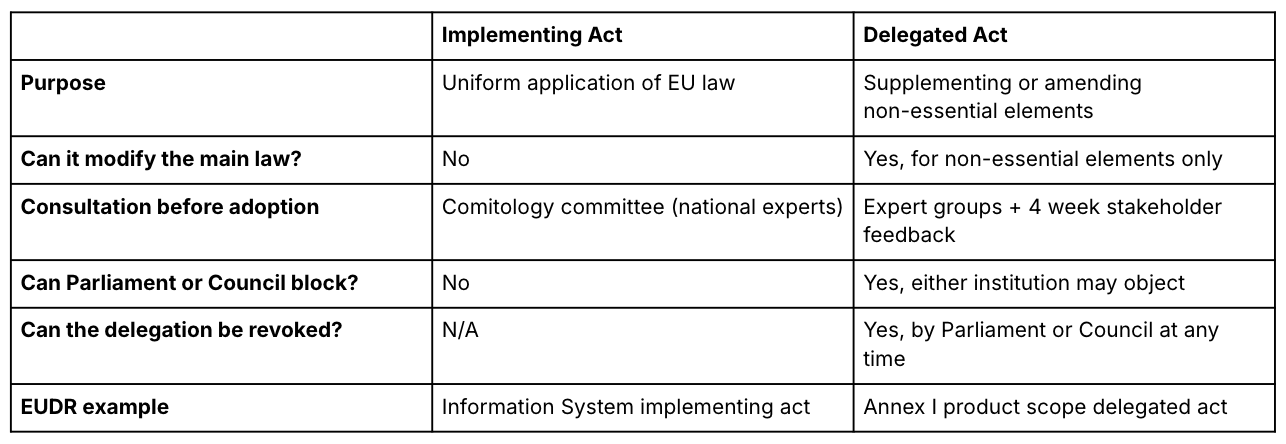
What this means if you are operating under the EUDR
Implementing acts are lower risk to monitor but operationally significant. The EUDR Information System implementing act does not change which products you need to cover or what due diligence you must perform. But it determines the technical environment in which you do all of that. Staying close to its development matters if your systems and processes need to be built around it.
Delegated acts can directly change your compliance perimeter. The Annex I delegated act is a clear illustration: whether your product is in scope or out of scope is one of the most fundamental questions the EUDR raises. A delegated act can move that line. The four-week feedback window that precedes formal adoption is a genuine opportunity to engage, particularly if you have concerns about how specific CN codes are being treated or whether an exemption applies to your products.
Both types are publicly trackable. Draft texts are published through the Commission's Have Your Say portal. The full lifecycle of delegated acts, from drafting through to entry into force, is visible in the Interinstitutional Register of Delegated Acts.
The Commission has confirmed it will not reopen the text of the EUDR itself. The application date for large and medium operators remains 30 December 2026, and 30 June 2027 for micro and small enterprises. Secondary instruments are now where the detail is being settled.
At Interu, we help operators cut through exactly this kind of complexity: mapping what is in force, what is coming, and what it means for your compliance posture. If you have questions about how the EUDR's delegated or implementing acts affect your specific obligations, get in touch.
Sources: European Commission · Council of the EU


.jpg)
